For finance
Revenue you can account for
Every session is priced by one tariff engine and recorded once. Revenue-assurance checks flag exceptions and value at risk before month-end, not after it.
EV charging infrastructure management
Manage EV charging infrastructure, optimise available power capacity and monitor site performance through one intelligent platform.
The Command Centre: a week of charging, live sessions and what needs a person, on one screen.
Start with your role
Shopping centres and commercial property: tenants’ supply first, and a plan for Eskom or municipal outages.
Charge point operators: remote operations, tariffs and VAT, and charge records finance can audit.
Solar and electrical installers: commission properly, then support clients remotely as an ongoing service.
Investors and property owners: usage and availability per site, with finance evidence from the operator’s exports.
Hotels and game lodges: overnight charging within what your solar, battery or generator can carry.
Fleet and logistics operators: depot charging planned around shifts and the depot’s connection.
Standards and local billing
The commercial challenge
Chargers are the easy part. These are the costs that decide whether a charging site pays.
Most buildings already use much of their connection at peak, and a bigger supply takes time and money to arrange. A site assessment shows whether the spare capacity is enough or an upgrade is still needed.
During Eskom or municipal load-shedding, chargers on an inverter or generator can take capacity the building needs, so many sites switch charging off at every outage.
A reset in Polokwane or a firmware check in Durban costs a vehicle and a day, and nobody has one view of what is working.
Finance needs each session priced with the right tariff and 15% VAT in rand, in a record nobody can quietly change afterwards.
Landlords and investors want to see how their chargers perform for themselves, without being given the keys to the back office.
Energy and power management
Each site gets an EV budget: the lowest of your limit, the time-of-use band and the grid headroom left after the building.
During a planned outage the budget drops to the backup-power limit you set, so cars charge more slowly instead of overloading the inverter or stopping altogether.
When the grid goes down, charging drops to what the backup can carry.
Centralised multi-site operations
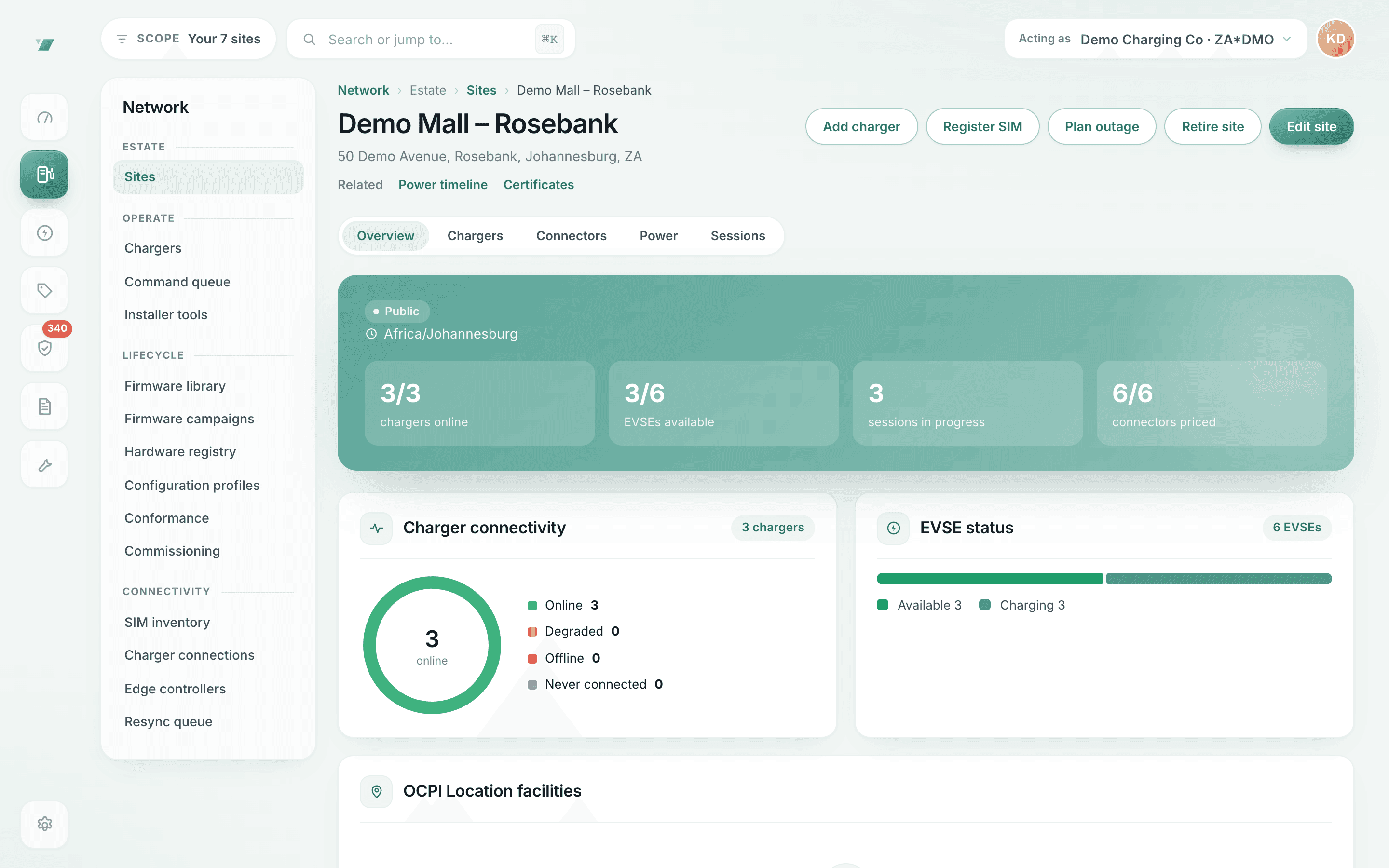
From Johannesburg and Polokwane to Durban and Knysna, every site keeps its own limits, prices and VAT. See what is charging and what needs a person across the estate, or open one site.
Every site on one map, from the city to the highway.
Charger monitoring and remote operations
See each charger’s connectivity and connector status as it reports it, and act on it without a site visit.
Financial visibility and owner reporting
For finance
Every session is priced by one tariff engine and recorded once. Revenue-assurance checks flag exceptions and value at risk before month-end, not after it.
For property owners and investors
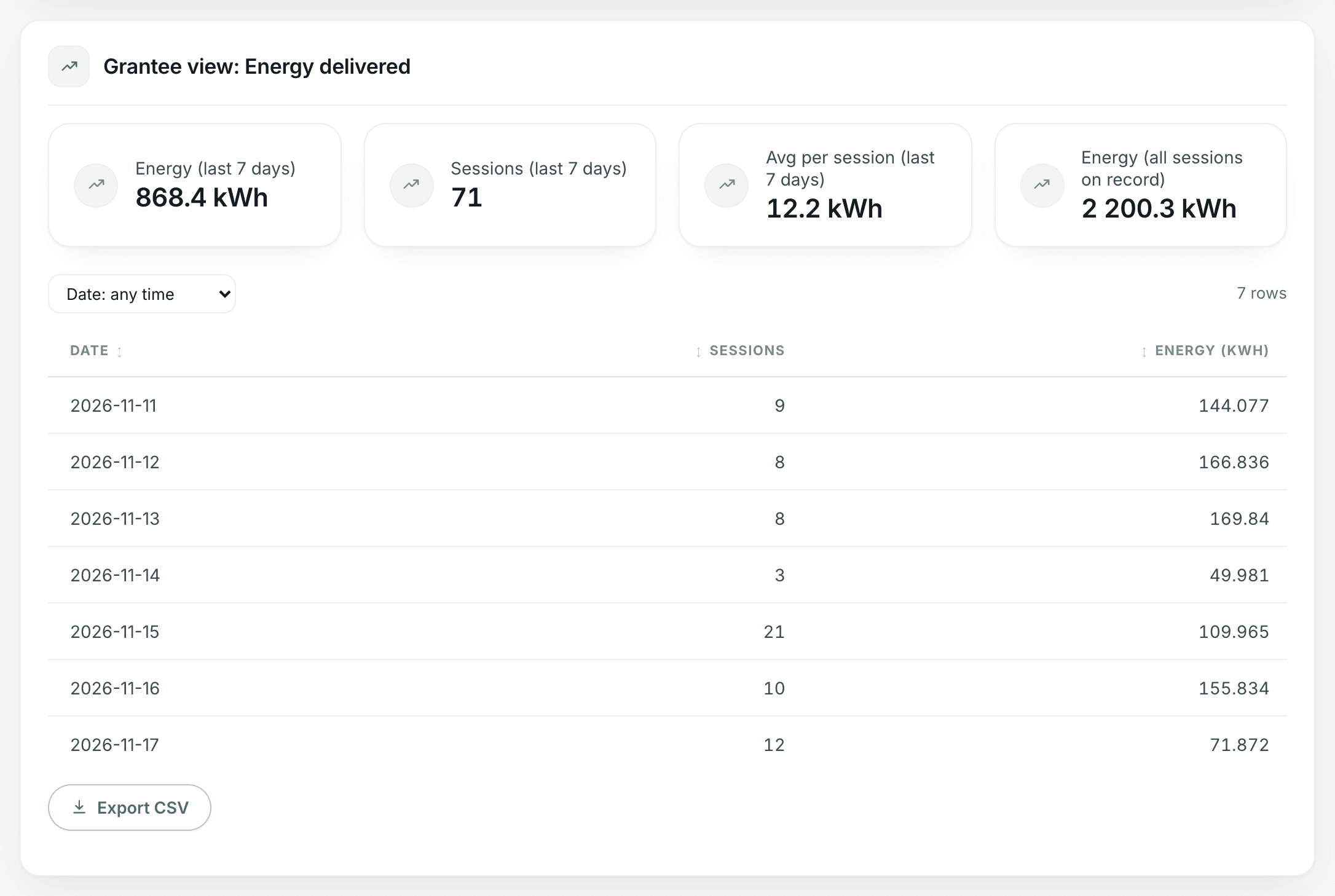
Give a landlord, host or funder their own portal: energy delivered and sessions per day for the sites they care about, with no prices and nothing they can change.
Industry applications
A shopping centre worries about its tenants’ supply, a lodge about its generator, a funder about evidence. Start with the page closest to yours.
How Getz Network works
Chargers talk to Getz Network over OCPP. Driver apps are reached only through Getz Hub, over OCPI.
We review your supply, backup system, chargers and what owners and finance need to see.
Chargers connect over OCPP and stay unpublished until their commissioning checklist is signed off.
Site limits, the backup-power limit, and tariffs in rand with 15% VAT.
Remote operations, charge records, accounting exports and a read-only portal for owners.
The product
Real screens, captured with a fictional demonstration operator: sites, chargers, energy, reporting, tariffs, records and the owner portal.
You control what a site publishes and whether every connector has a price before it goes live, so a half-ready site never reaches drivers.
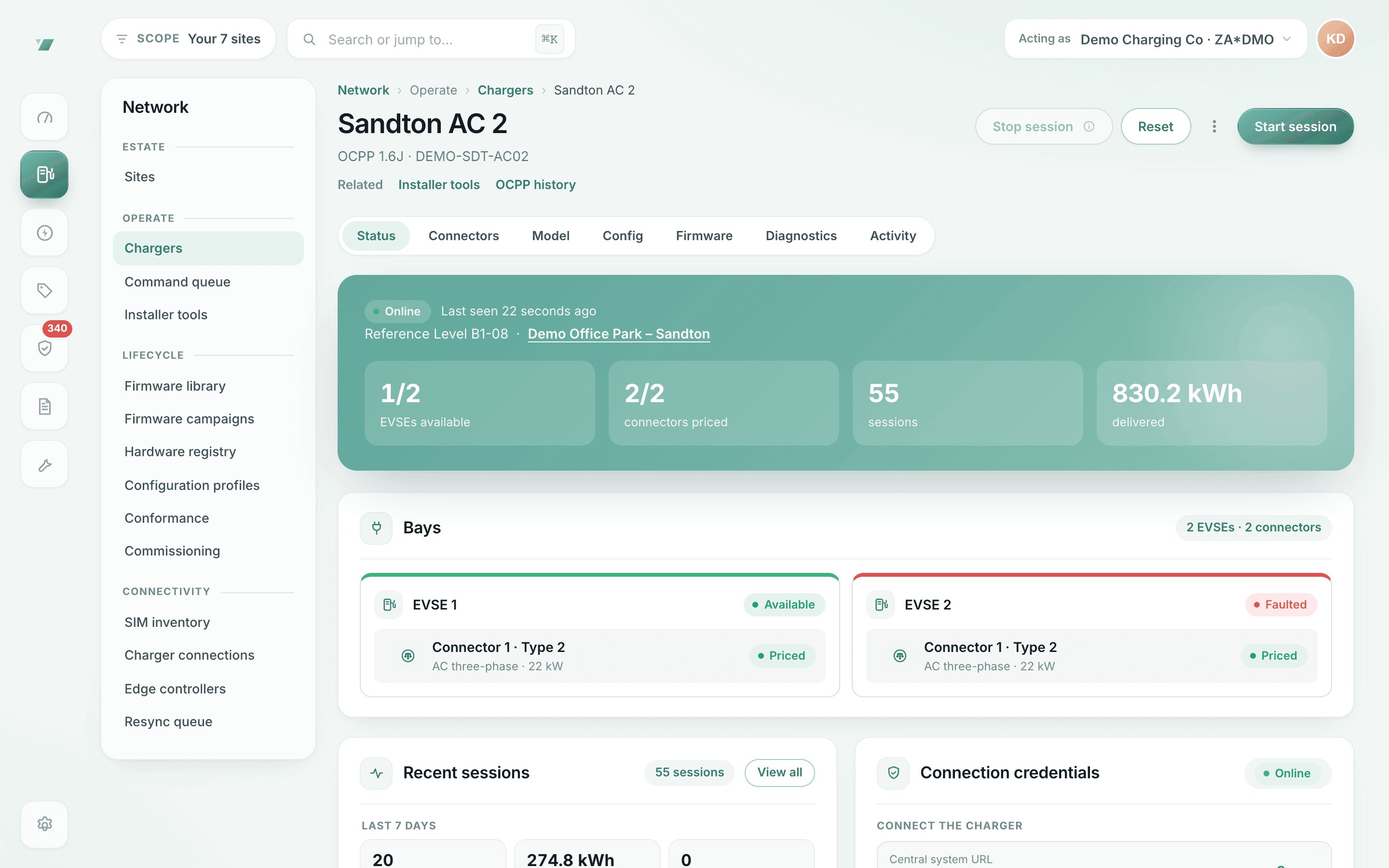
Reset, unlock or change availability remotely and turn the alert into a work order, instead of driving out to find out what is wrong.
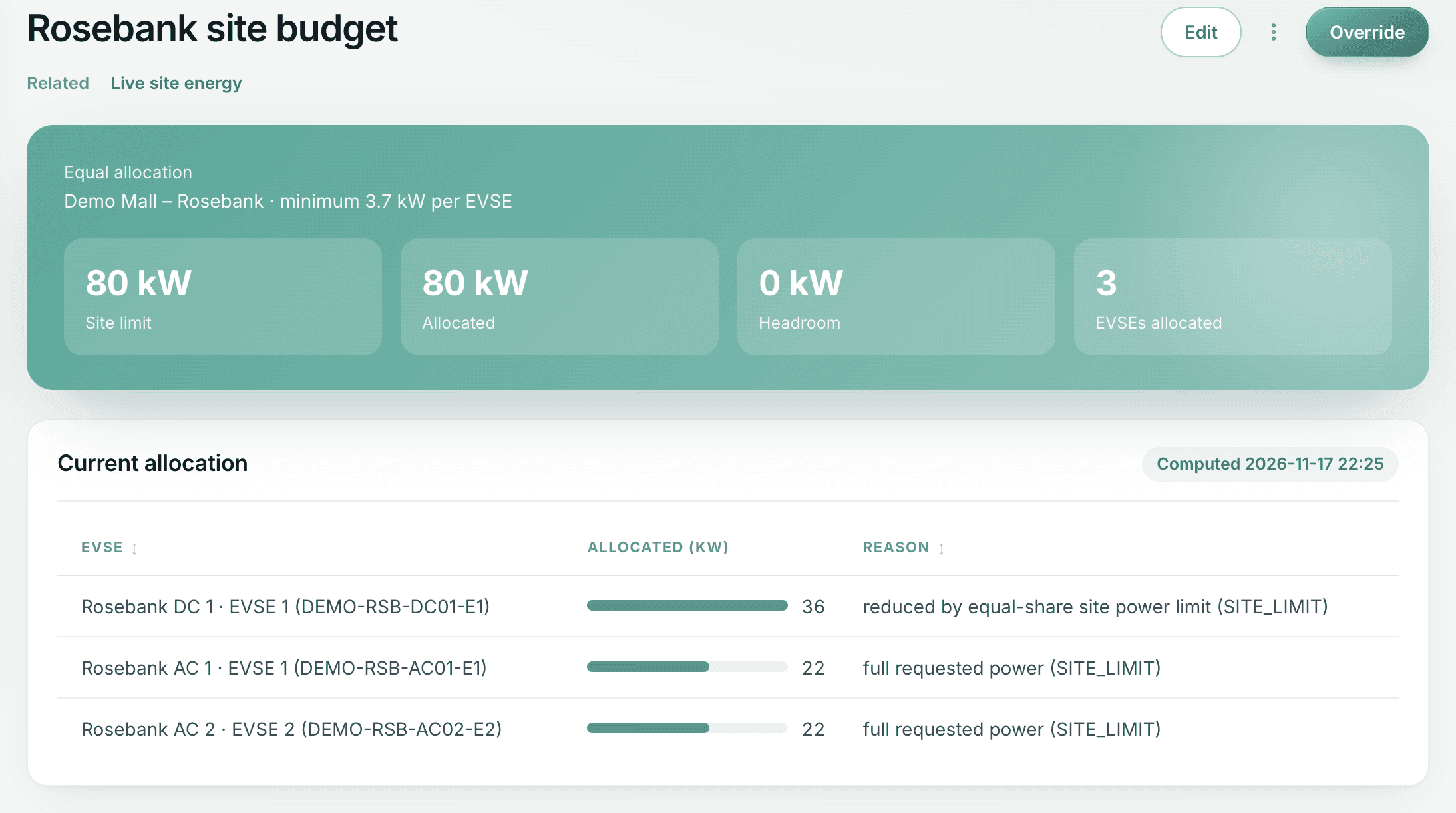
Set the site limit, grid limit and site meter. Charging profiles keep EV load inside the budget, so it never competes with the building for supply.
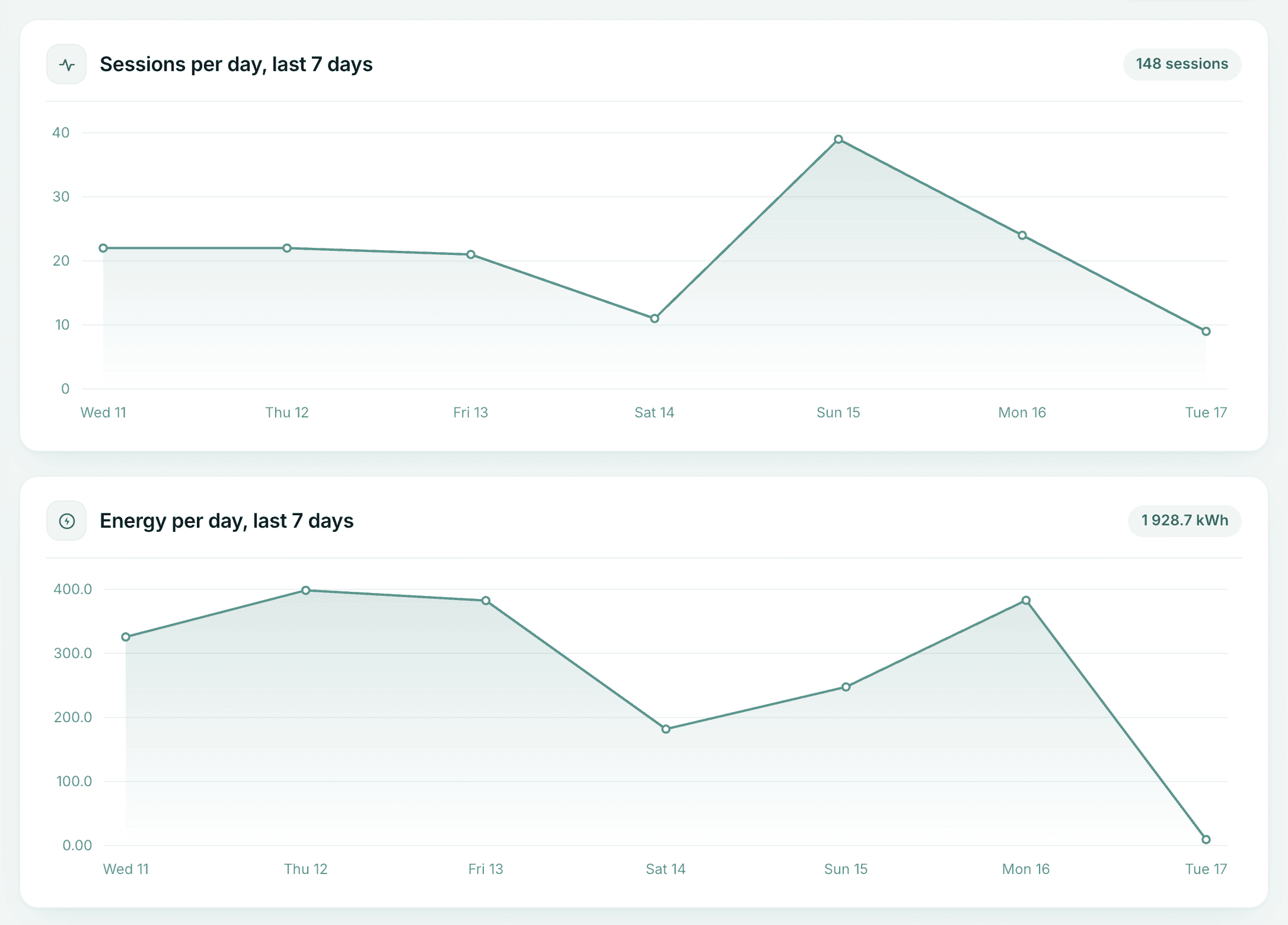
Sessions and energy per day across every site or one, from the same records finance uses, so quiet sites and busy days show up early.
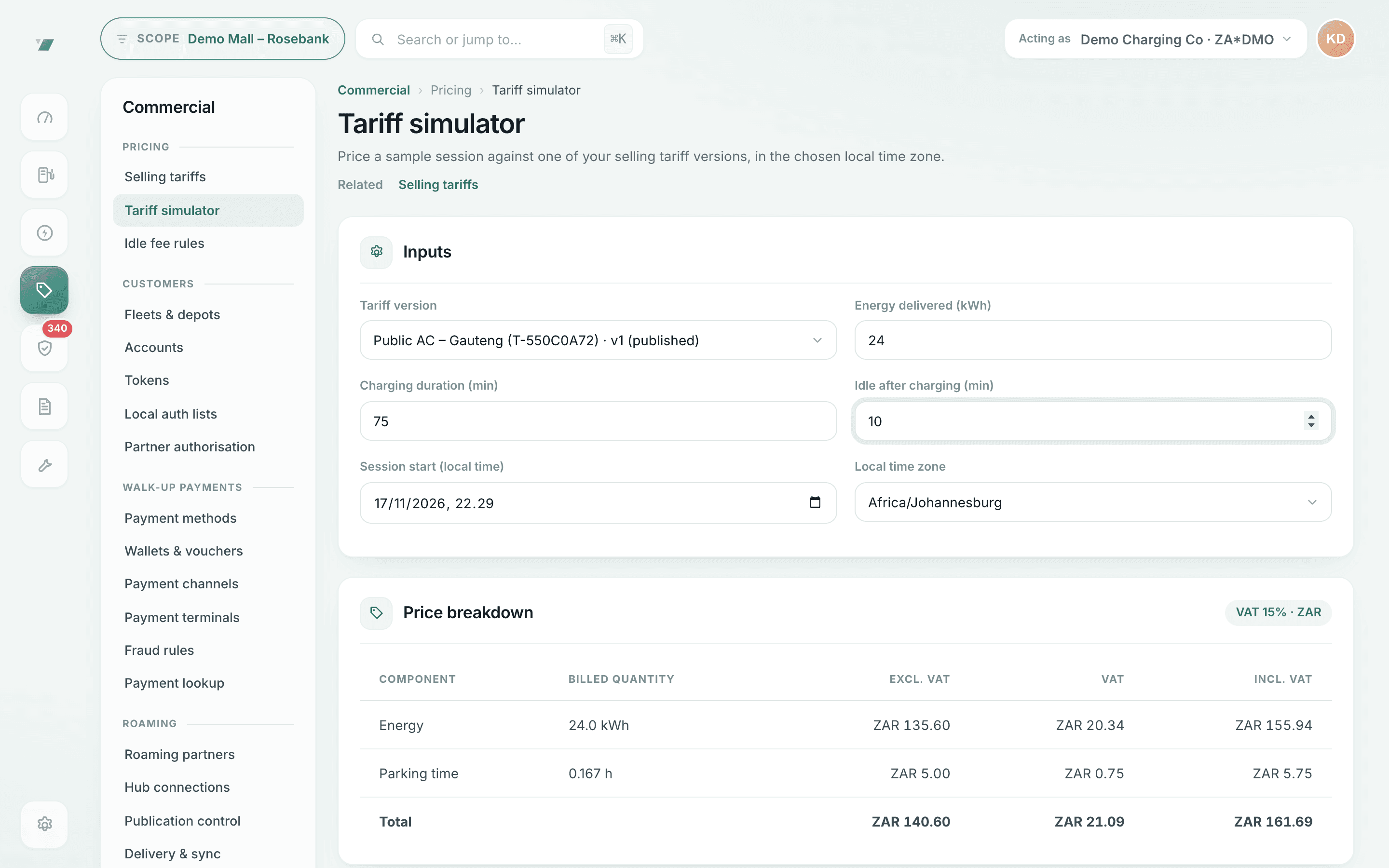
Energy, time, idle and flat fees by time of day, with VAT. The simulator shows each price component before a tariff is published, so mistakes are caught in the office.
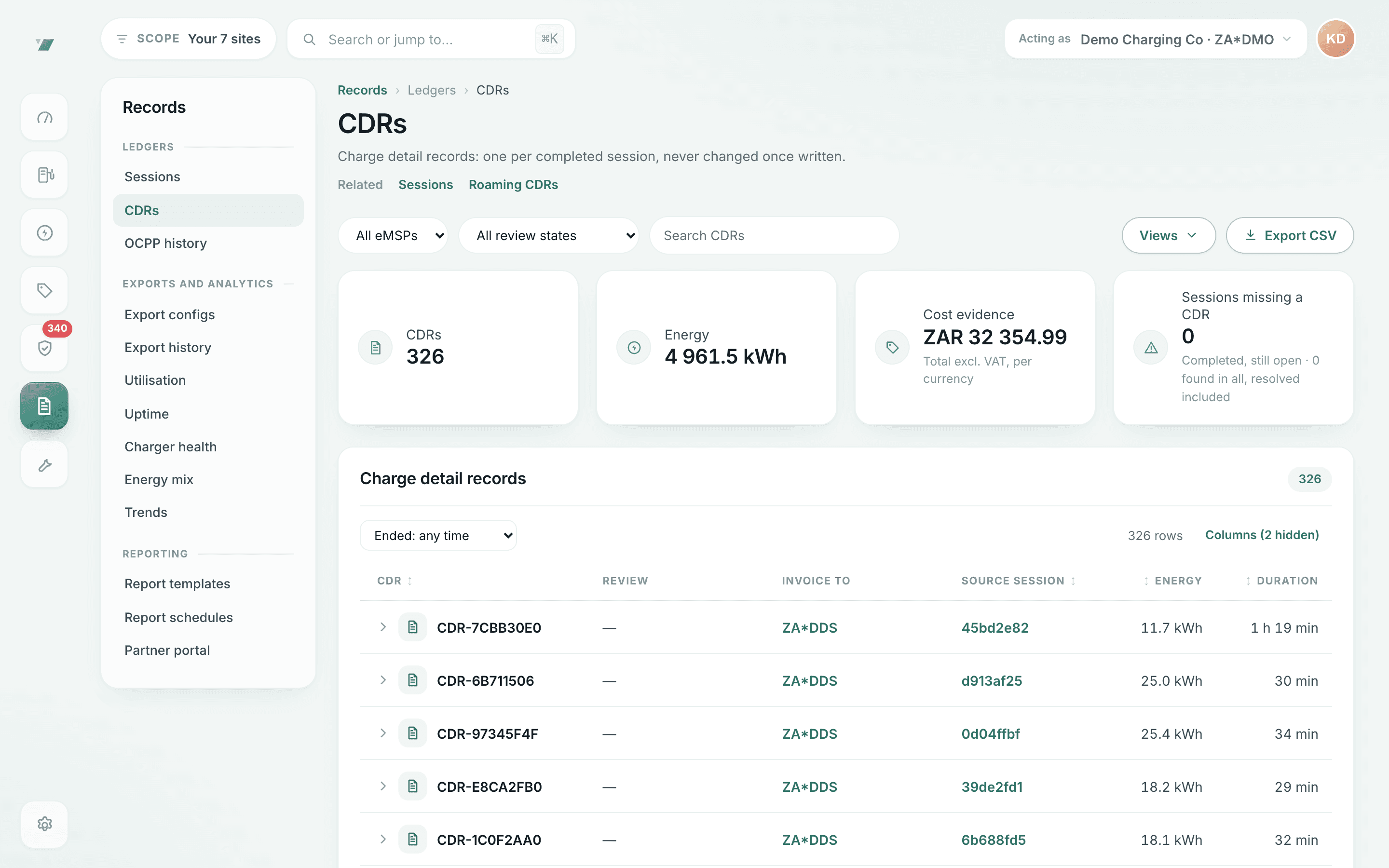
Export CSV, Xero, QuickBooks or Sage files on demand or on a schedule, so month-end is a download rather than a reconciliation project.
Hosts and investors see availability, energy and sessions for their own sites, with no prices or token ids. Grants expire and can be revoked at once.
Getz Network is a charge point management system (CPMS): the back-office software a property owner, charging operator or fleet uses to run EV chargers. It connects to chargers over OCPP, manages charging within the site’s grid and backup-power limits, prices sessions in rand with 15% VAT, and keeps charge records for finance teams, owners and funders.
Yes, within a limit you set, for outages on record. During a planned outage on the site’s calendar, Getz Network caps the site’s EV charging at the backup-power limit you configure, so cars keep charging at a lower rate instead of stopping. Outages from Eskom or municipal schedules are entered by your team or created from work orders; automatic schedule import is coming soon. How chargers behave in a cut that is not on record depends on the backup system and the settings agreed with your installer at commissioning. See backup-power-aware charging.
Chargers that speak OCPP 1.6J or 2.0.1 can connect, whatever the vendor. Which remote commands, firmware updates, smart-charging profiles and offline behaviour work depends on the model and its firmware, so each model is checked at commissioning before it goes into service. Tell us your models in a site assessment request and we will say what has to be tested.
Yes. Each site carries its own country, and sessions are priced in rand with 15% VAT for the session date. Amounts are kept in whole cents. An estate that crosses borders keeps each site’s own currency and tax. Rates are configuration and are confirmed with your finance team.
We start with a site assessment: your chargers, your grid connection and backup system, and what you need to report. We then commission Getz Network on your first sites with the limits and prices agreed up front, and extend it across the estate from there. Request a site assessment.
A demonstration walks through the back office with demonstration data. A site assessment looks at your real supply, backup power and chargers.